Issue qualificationinfrastructure.
Comainter parses stacktraces, detects duplicates, verifies runtime environments, and isolates root causes before developer reports interrupt engineering teams.
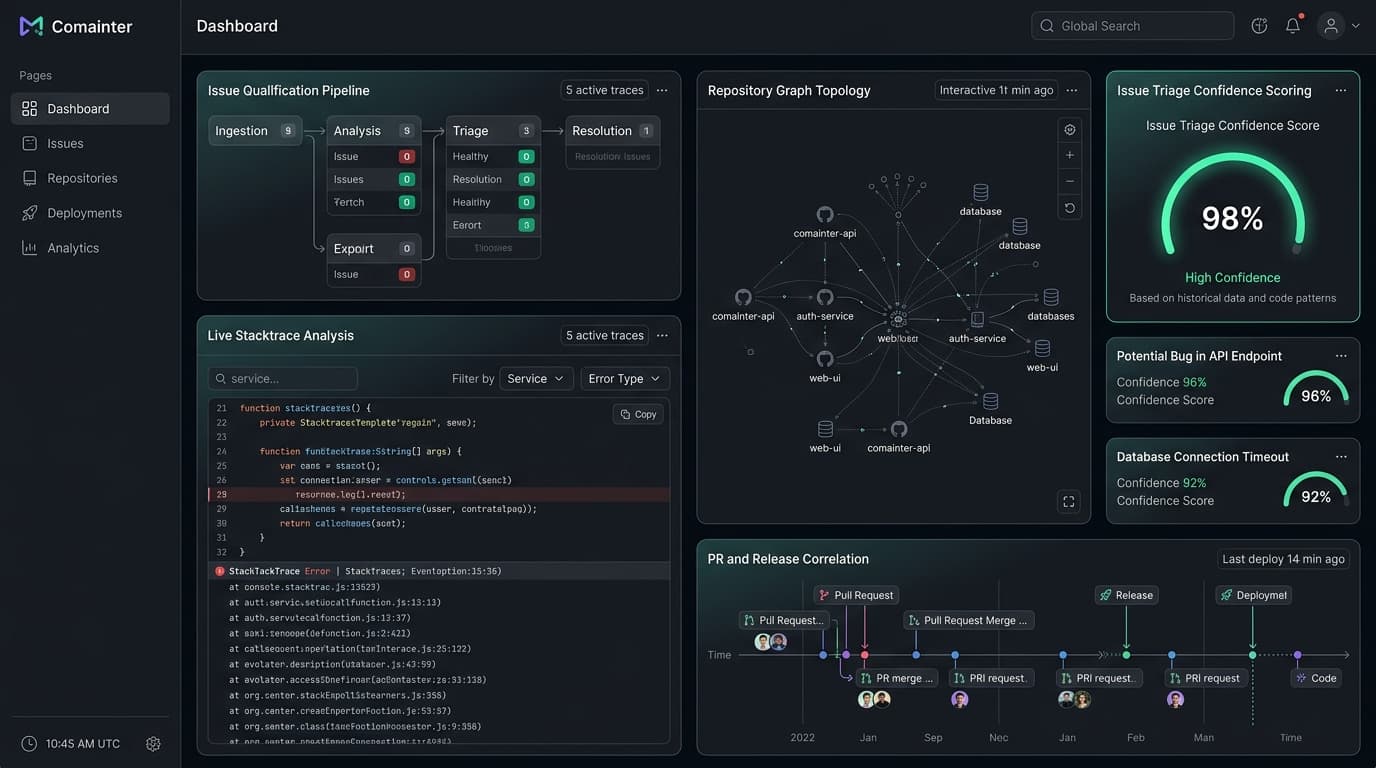
ENGINEERED FOR MODERN DEVELOPER PLATFORMS & HIGH-VOLUME OSS REPOSITORIES
How Comainter qualifies issues before engineering triage.
Most developer issues are incomplete, duplicates, or unsupported configs. Comainter runs a 4-tier pipeline to isolate real defects from ecosystem noise.
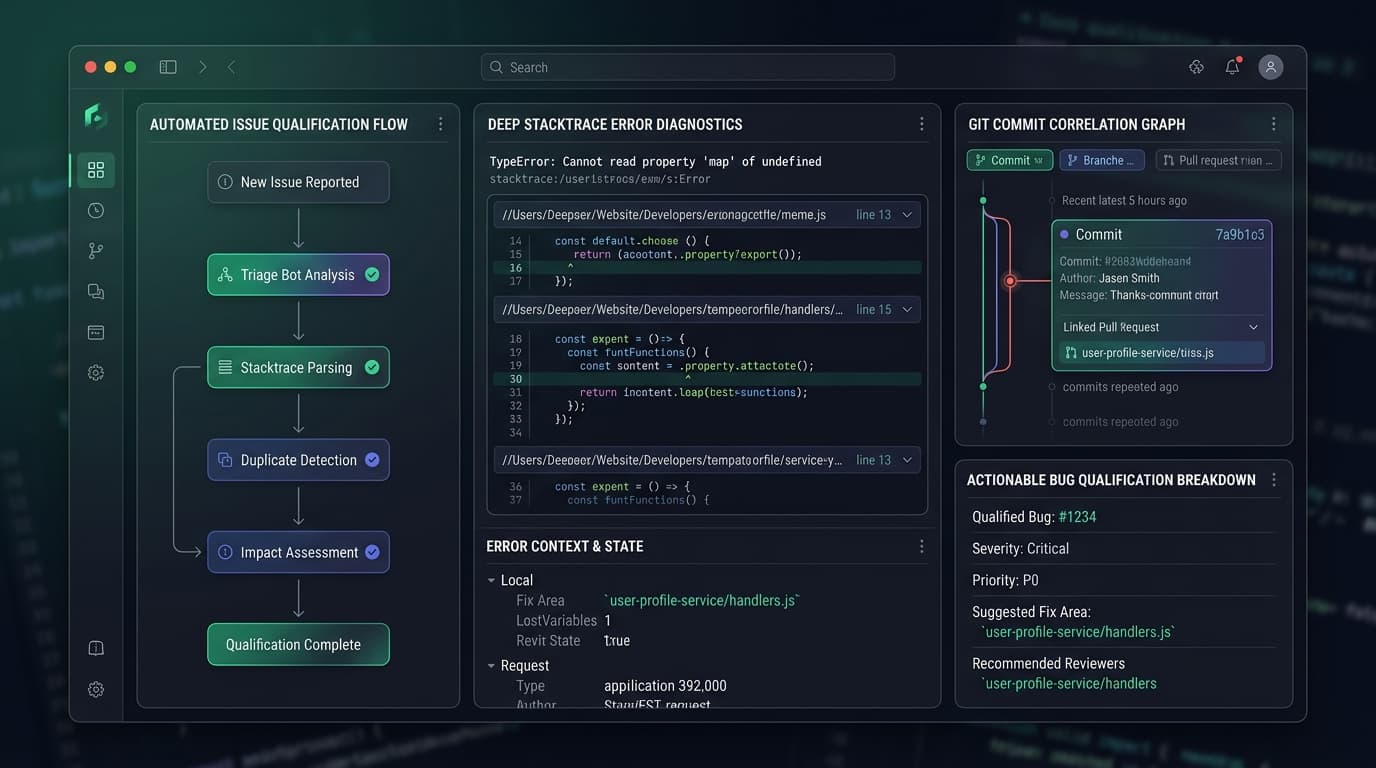
Environment & Syntax Validation
Validates Node, Python, or Go version, lockfiles, flags, and configuration schemas before parsing.
Vector Similarity & Deduplication
Computes semantic cosine similarity over open and closed issues, identifying duplicates in under 50ms.
Deep AST & Stacktrace Symbolication
Maps minified stacktraces to repository source files, recent PR diffs, and pinpointed line ranges.
Confidence-Scored Triage & Deflection
Issues with <80% actionability are deflected with reproduction guidance. Verified bugs route directly to code owners.
Inspect live qualification in action.
Select an incoming issue report to inspect how Comainter parses, verifies, and executes qualification decisions in real time.
Uncaught OAuth callback race condition in token exchange
Stacktrace matches regression introduced in PR #3891 (commit 7a9b1c0). Identified duplicate report #4812 with exact symbol collision.
Pipeline Execution Steps:
// packages/auth/src/exchange.ts:42
export async function exchangeCode(code: string, session: Session) {
  // CRITICAL: Mutex missing during concurrent callback exchange
  const token = await tokenProvider.issue({ code, tenant: session.tenantId });
  await sessionStore.commit(session.id, token); // <-- Race condition here
  return token;
}SYSTEM CAPABILITIES
Built for platform engineers, not generic triage.
Comainter operates deep within your repository topology to convert ambiguous bug reports into verified, actionable engineering tickets.
Stacktrace Symbolication
Reverses minified client and server stacktraces directly back to repository Git commits, branch heads, and exact function definitions.
Repository Topology Graphs
Maps multi-package monorepos and microservice boundaries to know exactly which subsystem owns an error before alerting maintainers.
Semantic Deduplication
Aggregates burst reports during outages or breaking releases into master issues, eliminating redundant comments and multiple PRs.
Environment Reproduction Check
Identifies invalid CLI flags, unpinned dependency conflicts, and unsupported runtime versions automatically.
PR & Release Correlation
Determines whether an reported bug is already addressed in an unreleased pull request or scheduled for the next tag.
Zero Model Training Guarantee
Proprietary ASTs and issue history remain private to your enterprise tenant. Comainter never trains shared models on your code.
INFRASTRUCTURE PRICING
Transparent plans for ecosystems of any scale.
Free forever for open source repositories. Scalable pricing for engineering platforms.
Open Source
For public repositories, community maintainers, and developer ecosystem libraries.
Platform Team
For developer platforms, API companies, and high-velocity support engineering teams.
Enterprise
For enterprise infrastructure companies with stringent compliance and isolation demands.
OPERATIONAL ARCHITECTURE
Frequently asked questions.
How does Comainter differ from generic AI issue bots?
Generic bots write shallow summary comments or hallucinate answers without understanding your repo. Comainter is deterministic infrastructure software: it parses stacktraces against your actual Git commits, validates runtime environments, runs similarity search against closed incident history, and only escalates verified bugs with reproduction steps.
Does Comainter train models on our proprietary codebase?
Never. Your source code and issues are indexed in an isolated tenant environment with strict cryptographic isolation. We do not use your proprietary repositories or bug reports to train public models.
What issue trackers and developer tools are supported?
Comainter integrates directly with GitHub Issues, GitLab, Jira, Linear, Slack, Discord developer forums, and Discourse. It operates non-intrusively through webhooks and API tokens.
Can Comainter automatically close unsupported config reports?
Yes. You have full policy control. You can set Comainter to autonomously reply with exact documentation citations for known unsupported environments, or stage deflection replies for human one-click sign-off.
How is repository context and history indexed?
Comainter indexes your AST, commit history, releases, and dependency lockfiles. When a report arrives, it correlates the stacktrace against historical changes to determine the exact PR that introduced the behavior.
Stop treating every bug report as an interruption.
Equip your repository with issue qualification intelligence today. Join top platform engineering teams.